Decorative LED Lights for Home, Office and Outdoors
Good lighting does two jobs: it lets you see clearly, and it sets the mood of a space. The best rooms combine both, with bright everyday lights for tasks and softer decorative lights for character. This page helps you pick the right mix, the right tone and the right brightness for every space.
What Are Decorative LED Lights?
Decorative LED lights for home are fixtures chosen for mood and style as much as brightness. They add accent and ambient light to features such as staircases, skirting, walls, ceilings and outdoor facades, and work alongside your main lights rather than replacing them.
Common decorative uses include:
Footlights and skirting lights that guide the way along stairs and corridors at night
Downlights with a warm tone to create a soft, even glow in living areas
Accent lights that highlight a feature wall, artwork or niche
Facade and garden lights that make the exterior look finished after dark
Choosing LED Lights for Home: 3 Numbers That Matter
When you buy LED lights for home, judge them by lumens, colour temperature and CRI, not by watts. Watts only tell you how much power a light uses; these three numbers tell you how it will actually look.
80 or above for homes; higher for dressing areas and retail
Which tone for which room? Warm white suits bedrooms, living rooms and dining areas. Neutral white works well in kitchens, bathrooms and home offices. Cool daylight suits study tables, garages, workshops and utility spaces.
Which Light Goes Where?
A well-lit space uses three layers: ambient light for general brightness, task light for focused work, and accent light for decoration.
Light type
Layer
Best for
LED bulb
Ambient / task
Existing holders, lamps, pendants
LED tube light / batten
Ambient / task
Kitchens, garages, shops, offices, corridors
Panel light
Ambient
False ceilings in homes, offices and clinics; even, glare-free light
Downlight
Ambient / accent
Living rooms, bedrooms, lobbies; recessed or surface-mounted
Footlight / skirting light
Accent
Staircases, corridors, bedside paths
Flood light
Outdoor accent / security
Facades, gardens, parking, signage
Street light
Outdoor ambient
Colony roads, campuses, driveways
Industrial light
Ambient
Factories, warehouses, high-ceiling spaces
Emergency light
Safety
Staircases, exits and corridors during power cuts
Panel light or downlight? A panel light spreads light evenly over a wide area, while a downlight casts a more focused pool of light. Many homes use panels for main light and downlights for a softer, layered look.
Decorative Lighting Ideas, Room by Room
Living room: warm downlights around the edges, an accent light on the feature wall, and a dimmer for movie nights. Pair the lighting plan with big ceiling fans so fixtures and blades do not cast moving shadows.
Bedroom: warm ambient light, a soft footlight near the bed for night-time walks, and reading light at the headboard.
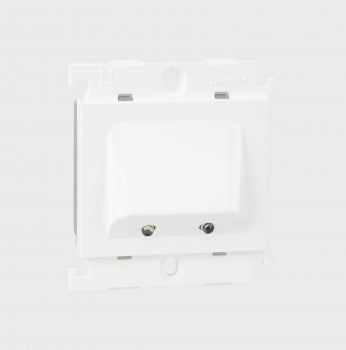
Staircase and corridors: footlights or skirting lights at step or floor level. Modular footlights fit into a standard switch board alongside your sockets and switches, so no separate fitting is needed.
Dining area: a warm pendant or focused downlight over the table.
Kitchen: neutral white panels or tubes for work surfaces, plus under-cabinet light for tasks.
Balcony, facade and garden: weather-rated flood or wall lights to highlight textures and plants.
How Much Light Does a Room Need?
Quick formula: lumens needed = recommended lux × room area in square metres. The values below are general guidelines for homes; tasks such as reading or cooking need more light than relaxing.
Room
Guideline (lux)
Example: 12 m² room
Living room
100–150
1,200–1,800 lumens
Bedroom
100–150
1,200–1,800 lumens
Kitchen
300
3,600 lumens
Study / home office
300–500
3,600–6,000 lumens
Bathroom
150–200
1,800–2,400 lumens
Corridor / staircase
50–100
600–1,200 lumens
Spread the total across several fixtures rather than one bright light, so the room feels even and comfortable.
Outdoor, Commercial and Emergency Lighting
Flood lights: for facades, sign boards, parking and security lighting. For outdoor use, look for an IP65 or higher rating, which indicates protection against dust and water jets.
Street lights: for colony roads, campuses and long driveways.
Industrial lights: for factories and warehouses with high ceilings, where uniform light matters for safety and productivity.
Emergency lights: battery-backed lights that keep exits and stairs visible during a power cut.
Solar and battery options: some outdoor lights charge from sunlight or run on rechargeable batteries, useful where wiring is difficult. For larger outdoor setups, you can also explore solar panels in India to power them.
LED Buying Checklist
Check lumens and efficacy: lumens per watt tells you how efficient the light is.
Keep one colour temperature per room so the light looks consistent.
Check CRI: 80 or above for living spaces.
Confirm dimmability: only fixtures marked dimmable work with dimmers, and the dimmer must be compatible.
Check the IP rating for bathrooms, balconies and outdoor areas.
Look for the BIS standard mark on LED lamps and fittings.
Protect the circuit: LED drivers are sensitive to voltage spikes, so use the right switchgear and protection, including surge protection, and correctly sized wiring (see our guide to the best wire for house wiring).
Plan for control: if you want schedules, scenes or app control, consider smart home devices at the planning stage.
Common Lighting Mistakes to Avoid
Buying by watts: two lights with the same wattage can differ widely in brightness.
Mixing warm and cool tones in the same room.
One bright light in the centre: creates glare and dark corners; layer several sources instead.
Using indoor fittings outdoors: without the right IP rating, moisture shortens their life.
Dimming non-dimmable LEDs: causes flicker and buzzing.
Shop Lighting at MGCKART
MGCKART, by MK SR Electricals and Instrumentation Pvt Ltd, lists lighting from Havells and Legrand alongside all electrical items for your project. Browse by product type:
LED bulbs and LED tube lights
Panel lights and downlights
Decorative footlights and skirting lights
Flood lights and street lights
Industrial lights
Emergency lights
Filter by brand and voltage (230 V AC, 12 V DC, rechargeable and solar-charging options) to find the right light for each space.
Frequently Asked Questions
Which is better for home: warm white or cool white LED?
Warm white (2700K–3000K) suits bedrooms and living rooms. Neutral or cool white (4000K–6500K) suits kitchens, study areas and workspaces.
How many lumens do I need for a bedroom?
As a general guideline, about 100–150 lux, which is roughly 1,200–1,800 lumens for a 12 m² bedroom, spread across more than one fixture.
Are all LED lights dimmable?
No. Only LEDs marked dimmable work with dimmers, and the dimmer must be compatible with the fixture.
What are decorative LED lights used for?
They add accent and mood lighting to staircases, walls, ceilings, corridors and outdoor facades, alongside the main room lights.
Which LED lights are suitable for outdoor use?
Fixtures with an IP65 or higher rating, such as flood lights and weather-rated wall lights.
What is the difference between a panel light and a downlight?
A panel light spreads light evenly over a wide area; a downlight gives a more focused pool of light.